Google Ads for small businesses: how it works, what it costs and when it pays off
Google Ads works as an auction: you pay for each click and Google ranks ads according to your bid and the quality of your ad and your website, not just by who pays most. There is no minimum spend. As a reference, a click costs between €1.50 and €2.50 for local searches in the Maresme and between €3 and €6 in Barcelona city, so with €300 a month you buy about 150 clicks locally or between 50 and 100 in the city. If you delegate management, add that cost separately (at GNERAI, from €150/month).
1 / 10Google Ads puts you in front of people who are already looking for you
Google Ads for small businesses is the most direct way to appear at the top of Google when someone searches for what you sell, from day one. But it is also the fastest way to spend money on clicks that do not buy. In this guide we explain, without jargon, how it works, what it really costs, how much to invest and the mistakes that make most campaigns fail.
Google Ads puts you in front of people who are already looking for you
Google Ads is active-demand advertising: your ads appear just when someone searches for what you offer. That is its great strength. While SEO takes months to give you visibility, Google Ads puts you at the top from day one, paying for each click you receive.
The trade-off is that, as soon as you stop paying, you stop appearing. That is why it is worth understanding properly how it works, what it really costs and when it pays off, so you do not end up paying for expensive clicks that never turn into customers.
«Google Ads does not create demand: it captures it. That is why it works so well when your customer is already searching for what you sell.»
How it works: an auction, not whoever pays most
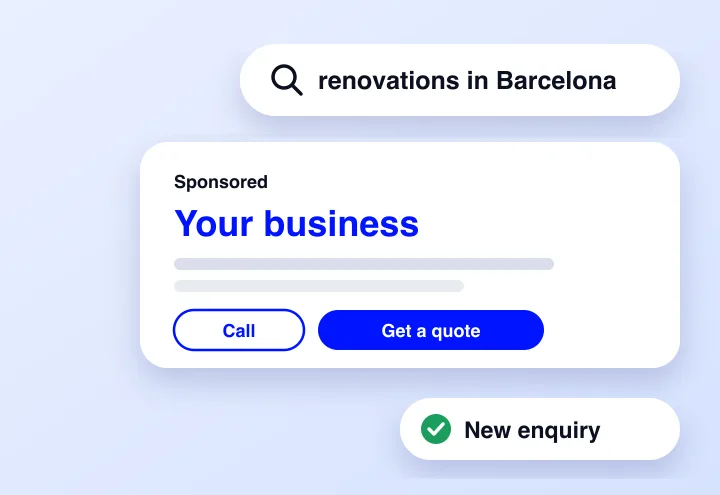
Many people believe that on Google Ads whoever pays most wins. That is not quite right. Every time someone searches, Google runs an instant auction. Google Ads Help explains it itself: the order is calculated from your bid amount, the quality of your ads and landing page, the context of the search and the expected impact of extensions.
And it makes clear that it is not like an art auction, where the highest bidder always wins.
This means a relevant ad, with good copy and a page that answers the search, can appear above another that bids more but is worse. In practice, looking after relevance not only improves your position: it also lowers your cost per click.
Quality Score: what lowers your cost per click most
Google scores each keyword on three things: whether people are likely to click on your ad, whether the ad relates to what they searched for and whether your page gives them what they expected.
A small business cannot compete on budget with a national chain, but it can on relevance: ads that repeat what the person searched for and a page that talks about that specific service, in that area.
How much Google Ads costs for a small business
There is no single price: the cost per click depends on your sector and the competition. Highly contested sectors pay for expensive clicks; specific niches, much less. But the most common mistake is looking only at the cost per click and forgetting the rest of the equation.
What makes up the real cost
- The budget you invest in clicks (what goes straight to Google).
- The average cost per click in your sector, which sets how many visits that budget gives you.
- The percentage of those clicks that turn into customers (your website has a lot to say here).
- Management: the time, or the professional, that optimises the account so it is not wasted.
What a click costs in Barcelona and the Maresme
| Type of search | Indicative cost per click | Clicks with €300/month |
|---|---|---|
| Local searches in the Maresme | €1.50 – €2.50 | About 150 |
| Barcelona city | €3 – €6 | Between 50 and 100 |
| Highly contested sectors (lawyers, clinics, renovations) | Can exceed €7 | Fewer than 45 |
These are references so you know where you stand, not rates: the real price comes out of each day’s auction. For your specific case, Google’s Keyword Planner gives you a free estimate before you spend anything.
Two bills worth keeping separate
The ad spend goes straight to Google and you decide it. Management is the work of whoever sets up and optimises the campaigns. At GNERAI, management starts at €150 a month and the Google Ads + Meta Ads pair at €250 a month, always with no tie-in. You will find it all in online advertising prices.

A detail that surprises many people: Google can spend up to twice your daily budget on a day with a lot of traffic but, according to its official help, over a month it never charges you more than 30.4 times that daily budget.
How much to invest: work out your budget in three steps
Google Ads has no minimum spend, but with a very small budget you never get enough data to make decisions. The sensible way to work it out is to start from the end: how many customers you want.

- How many enquiries you need a monthFor example, 10 quote requests.
- What percentage of visitors contact youIf you do not know, measure it; for the example, let us say 5%. You would need 200 clicks.
- Multiply by the cost per clickAt €2 a click, that is €400 a month of ad spend.
Now the key question: does what a customer brings you comfortably cover what it costs to win them? If each enquiry costs you €40 and you close one in three, each customer costs you €120. If your service leaves you a €500 margin, it pays off.
If it leaves you €80, it does not, and you need to improve the website or choose other searches before increasing the budget.
The numbers in this example are round and indicative. With real data from your account, after four to six weeks you can redo the sums accurately.

Types of campaign (start with the simple ones)
Google Ads offers several formats, and they are not all for the same thing. For a small business starting out, the sensible approach is not to open ten fronts at once.
| Campaign | What it is | For a small business |
|---|---|---|
| Search | Text ads when someone searches | The best starting point |
| Performance Max | Automated campaign across all Google placements | When you already have measured conversions |
| Shopping | Products with photo and price | If you have an online shop |
| Display | Banners on other websites | For remarketing, not for starting out |
| YouTube | Video ads | If you have video and want brand awareness |

Search campaigns capture direct intent and are easy to measure. Automated ones such as Performance Max leave more decisions in Google’s hands and need conversion data so they do not spend blindly. Start with Search, learn with real data and expand only when that works.
If you are starting out with Google Ads, begin with Search campaigns. They capture people who are already looking for you, are easy to measure and are more forgiving of beginner mistakes.
Why small businesses fail on Google Ads
When we review the accounts of small businesses that say “Google Ads does not work”, we almost always find the same faults. None of them is the channel’s fault:

- Not measuring conversions. If the account does not know which click ended in a call or a form, nobody can optimise anything, neither you nor Google.
- Keywords that are too broad, with no negatives. You pay for searches such as “free”, “course” or “jobs” that are never going to buy from you.
- Sending traffic to the home page. The person searched for a specific service and lands on a generic page. A landing page for each service usually changes the result.
- Badly configured location. By default, Google can show your ad to people who are only interested in your area, not to people who are in it. For a local business, it is best to limit it to people who are actually there.
- Spreading a small budget across many campaigns. None of them ever gets enough data.
- Switching on automated campaigns without data. Performance Max or Display without measured conversions end up spending on what is cheapest, not on what sells.
- Not reviewing the search terms every week. That is where you see what you are really paying for.
 A real case×11.6return on ad spendIlla Fantasia · See the project →
Google Ads or SEO: when to use each
It is not a war: they are different tools for different moments. Google Ads gives you immediate results but you depend on paying; SEO takes time but builds an asset that brings in customers with no cost per click. The ideal for a small business is usually to combine them.
Use Google Ads when you need sales now, to launch something new, for seasonal campaigns or to compete for very commercial searches while your SEO is not there yet. And work on SEO in parallel so that, over time, you depend less on advertising.
We compare them with numbers in SEO or Google Ads: which to choose.
Advertising on Google for small businesses: the order that usually works
- A complete Google Business Profile with reviews.
- A fast website, with one page per service and measurement installed.
- A Search campaign with a few purchase-intent keywords.
- SEO in parallel, to depend less and less on paid clicks.
- Meta Ads or remarketing once the above is already converting.

A Google Ads agency for small businesses: what to ask for
You can manage Google Ads yourself if you have the time and the will to learn. If you delegate it, ask a Google Ads agency for small businesses for at least this:
- The account in your name. If you part ways one day, the history and data stay with you.
- Ad spend and management kept separate, so you know what goes to Google and what is their work.
- No tie-in, or a very short one.
- A report with the cost per enquiry, not just clicks and impressions.
- A weekly review of bids, ads and search terms.
This is how we run our Google Ads campaigns for small businesses: research into purchase-intent keywords, negative keywords, ad copywriting, conversions connected from GA4, weekly optimisation and a monthly report with the cost per enquiry.
Visits arrive the same day the campaigns go live, the first enquiries usually come in the first week, and real optimisation happens between the fourth and sixth weeks.

We help you make every click profitable
Well-managed Google Ads is one of the channels with the fastest, most measurable return for a small business. Badly managed, it is an expensive way of paying for visits that do not buy. The difference lies in relevance, targeting and having a website that converts.
At GNERAI we help small businesses in Barcelona and the Maresme set up and optimise their campaigns with the focus on the end customer, not on visits, and make sure the website is ready to convert that traffic.
You can see what the service includes, the prices and the process on our Google Ads agency in Barcelona page.
More real examples: UDB Sports
We'll send you our next advertising guide
Google Ads, Meta Ads and what we learn from every campaign, in your inbox. No spam.
Guides for your business, in your inbox
What we publish on websites, SEO, ads and AI for small businesses. No spam, unsubscribe in one click.
Frequently asked questions
How much does Google Ads cost for a small business?
Two parts: the spend on clicks, which you decide and pay to Google, and management if you delegate it. As a reference, a click costs between €1.50 and €2.50 for local searches in the Maresme and between €3 and €6 in Barcelona city. At GNERAI management starts at €150/month plus the ad spend.
Is there a minimum budget on Google Ads?
No. Google does not require a minimum spend and you set the daily budget. But with very little you never get enough data to make decisions. Work it out backwards: how many enquiries you want, what percentage of visitors contact you and what a click costs in your sector.
Why do small businesses fail on Google Ads?
Almost always for the same reasons: they do not measure conversions, they use keywords that are too broad with no negatives, they send traffic to the home page, they set up the location badly or they spread a small budget across many campaigns. These are set-up faults, not faults of the channel.
How long does Google Ads take to deliver results?
Visits arrive the same day the campaigns go live and the first enquiries usually come in the first week. Real optimisation happens between the fourth and sixth weeks, when there is enough data to know which searches convert and which only spend.
Is Google AdWords the same as Google Ads?
Yes. Google renamed AdWords to Google Ads in 2018. If someone talks to you about Google AdWords for small businesses, they are talking about exactly the same product. SEM is the broad term for all search engine advertising.
Can I manage Google Ads myself?
Yes, and with a small Search campaign it is a good way to learn. The hardest part is the day-to-day: reviewing search terms, adjusting bids and keeping measurement working. If you do not have time to do it every week, it ends up costing more than delegating it.
Which is better for a small business, Google Ads or SEO?
The usual approach is to combine them. Google Ads delivers results from day one but you depend on paying; SEO takes months but builds an asset that brings in customers with no cost per click. Many small businesses start with Ads to get traction and let SEO take over.
Do I have to sign up to a tie-in?
With us, no. Google Ads management has no tie-in and the account is in your name: if you leave one day, you keep it with its full history.
Further reading
Starting out with Google Ads, or want to stop losing money?
Request the free review of your campaigns and in less than 24 hours we tell you what budget makes sense for your business and what we would change in your campaigns.