
How long does it take to rank a website on Google?
Indexing and ranking are two different things with different timelines. Google can index a page in 48 hours or take weeks, depending on your domain’s authority and whether you have submitted the sitemap in Search Console. Ranking takes months: 6 to 12 for a new website, 3 to 6 if it already exists but has a poor technical base, and 2 to 4 if the base is healthy and only content is missing. With local SEO you notice it in weeks.
1 / 14Indexing is not the same as ranking
How long does it take to rank a website? It depends on what you are asking. Google indexing your page is a matter of hours or weeks; Google showing it near the top when someone searches is a matter of months. Here you have the real timelines for each phase, why you can be indexed and still not show up, and what to do to shorten both.
Indexing is not the same as ranking
It is one of the most common confusions when you launch a website: you publish the page, search for it on Google and it does not appear, and you think something is wrong. In reality you are mixing up two different things.
One is indexing: Google knowing about your page and storing it in its index. The other is ranking: Google showing it near the top when someone searches.
You can be perfectly well indexed and still not appear on the first page, because they are two different stages with different timelines. Understanding this difference saves you anxiety and helps you know what to do at each moment.

«Being indexed means Google knows you. Ranking means Google chooses you. They are two different things, with different timelines.»
Want to shorten those timelines? This is how we handle indexing and ranking in our Google ranking service in Barcelona.
What it means for Google to index your page
The process has three phases. First, Google crawls your page: a bot visits it and reads its content. Second, it processes it and decides whether to include it in its index, that enormous database all the results come from.
Third, when someone searches, Google chooses from the index which pages to show and in what order.
Indexing means your page gets through the first two phases and into the index. Until that happens, your page simply cannot appear in any search, however good it is. That is why indexing is the first goal of any new page.
 Real exampleSEES ProductionAn editorial online presence for a high-end audiovisual production company.+140% time on siteSee the project →
How long does Google take to index a website? From a few hours to several weeks
There is no fixed number, and anyone who gives you an exact one is misleading you. In practice, a page can be indexed in a few hours or take several weeks. Google’s own documentation for webmasters puts it this way: crawling can take anywhere from a few days to a few weeks. The difference depends on several factors.
What decides whether it takes hours or weeks
- The authority and age of your domain: a new website starts with less trust.
- Having a sitemap submitted in Search Console and internal links leading to the page.
- How often you update and publish new content.
- The page not being blocked by robots.txt or marked as noindex.
- The content being useful and unique, not a copy of another page.
How to get your website indexed on Google faster
You cannot force Google, but you can make it much easier for it and cut the timelines considerably.
What speeds up Google indexing you
- Submitting your sitemap.xml in Google Search Console and keeping it up to date.
- Using Search Console’s URL Inspection and clicking Request indexing on every new page.
- Implementing IndexNow to notify search engines such as Bing instantly.
- Linking to the new page from other pages on your website that are already indexed.
- Publishing original, useful content, which Google is more interested in indexing.
Getting your website indexed on Google with Search Console, step by step
- Add your domain to Google Search Console and verify that it is yours.
- Under “Sitemaps”, submit the address of your sitemap (usually yourdomain.com/sitemap.xml).
- Paste the URL of the new page into the inspection bar at the top.
- If it says it is not on Google, click “Request indexing”. Repeating it several times does not speed it up: Google puts a quota on these requests.
- Come back in a few days and check the page indexing report.
Getting a WordPress website indexed on Google
If your website runs on WordPress, first check under Settings > Reading that the “Discourage search engines from indexing this site” box is not ticked. It is the most typical oversight when publishing a website that was in testing.
SEO plugins such as Yoast or Rank Math generate the sitemap automatically; you just have to submit it in Search Console.
How to tell if your website is indexed on Google
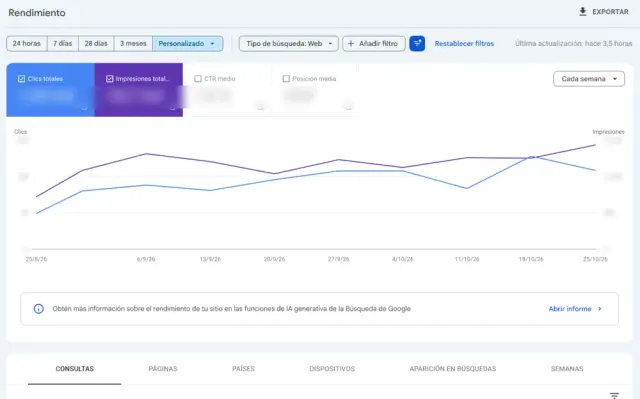
There are two quick ways to check. The first is to search Google for site: followed by your page’s URL; if it appears, it is indexed. The second, and more reliable, is to use Google Search Console’s URL Inspection tool, which tells you exactly whether the page is in the index, when it was last crawled and whether there is any problem.
If an important page is still not indexed after a couple of weeks, there is almost always a specific cause: a block in robots.txt, a forgotten noindex tag, duplicate content or an orphan page with no internal links.
Checking those points usually solves most cases. And if you also want to appear in AI assistants’ answers, the index that counts there is a different one: we explain it in how to appear in ChatGPT’s answers.
Google is not indexing my website: the seven real causes
When a page has gone weeks without getting into the index, it is almost never bad luck. In the audits we carry out, the reason is almost always on this list, and the first three explain most cases.
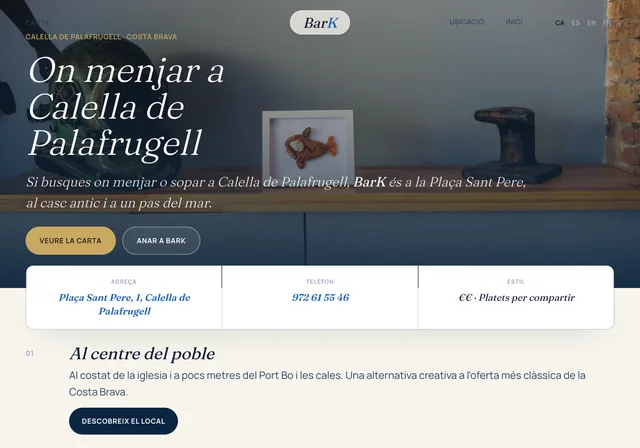
The way to find out which one applies to you is Search Console’s URL Inspection: it tells you whether Google has crawled the page, whether it has discarded it and why.
Why Google does not index a page
- A forgotten noindex tag, very common after moving a website from testing to production.
- A block in robots.txt that prevents that path from being crawled.
- The canonical points to another URL, so Google indexes that one and discards yours.
- Content that is too short or almost the same as another page on the site.
- The page receives no internal links: Google does not reach it.
- The sitemap does not include it, or the sitemap has not been submitted in Search Console.
- A new domain with no authority: Google crawls less and more slowly.
If Search Console says “Discovered – currently not indexed”, Google knows about the page but does not see it as a priority. It is usually fixed with internal links from pages that already rank, not by requesting indexing again.
How long it takes in each case, with specific timelines
A newly bought website is not the same as a new page on a domain Google already visits every day. These are the timelines we usually see in small business projects.
| Situation | Usual indexing time |
|---|---|
| New page on an active domain that publishes often | From a few hours to 3 days |
| New page on a domain with little activity | From 3 days to 2 weeks |
| Newly launched website, with a new domain | From 1 to 4 weeks for the main pages |
| Modified page | Google usually picks it up in days, but the change in ranking takes weeks |
| Website migrated to a new domain | Weeks; it is advisable to keep the redirects for at least a year |
These are orders of magnitude, not guarantees: they depend on the domain’s authority and how often you publish.

Want to know what is holding your website back on Google? In the free digital check-up we review your brand, your website, your Google Business Profile and your campaigns, and in less than 24 hours we tell you what to prioritise.
Indexed but not showing up: this is where ranking comes in
Google having indexed your page does not mean you will be near the top. Indexing is a matter of days; ranking, of months. Once you are in the index, Google decides your position based on hundreds of signals: the relevance of your content, the quality and speed of the page, the links pointing to you and the competition you face for that search.
That is why it is normal to see a page indexed in 48 hours that takes weeks or months to climb for the searches that matter. If you obsess over indexing but neglect content and authority, you will appear in the index but buried on page ten. Indexing is the entry ticket; ranking is winning the race.
Check first whether you are indexed before worrying about ranking. If you are not even in the index, no ranking optimisation can work yet.
And how long does it take to rank a website? Timelines depending on your starting point
This is the other half of the question, and the one that really shapes your investment. If indexing is measured in days, ranking is measured in months, and how many depends almost entirely on the starting point.
These are the ranges we see in real projects, not in hand-picked success stories. They are orders of magnitude, not guarantees: anyone who gives you an exact date is selling you hot air.
| Starting state of your website | Time to consistent organic traffic | Why |
|---|---|---|
| New website, with a domain with no history | 6 to 12 months | Google needs to crawl you, index you and assess whether it can trust your domain. |
| Existing website with poor SEO | 3 to 6 months | The base already exists and the job is to fix it, so progress is much faster. |
| Good technical base but little content | 2 to 4 months | Content aimed at real searches is added. It is the most rewarding scenario. |
| Penalised website or one with a spam history | 12 to 24 months | The link profile has to be cleaned up before building anything. |
| Local SEO with a well-optimised Google Business Profile | Weeks, not months | It is the fastest route there is if you sell in a specific area. |
According to a 2023 Ahrefs study of some 14 billion pages, 96.55% receive no visits at all from Google. Not because SEO is impossible, but because content is published without first looking at what the potential customer is really searching for.
If you want to see how each phase is handled, you will find it in our guide to ranking your website on Google. A real example: with Razol Parquet organic traffic grew by 85% in 6 months.
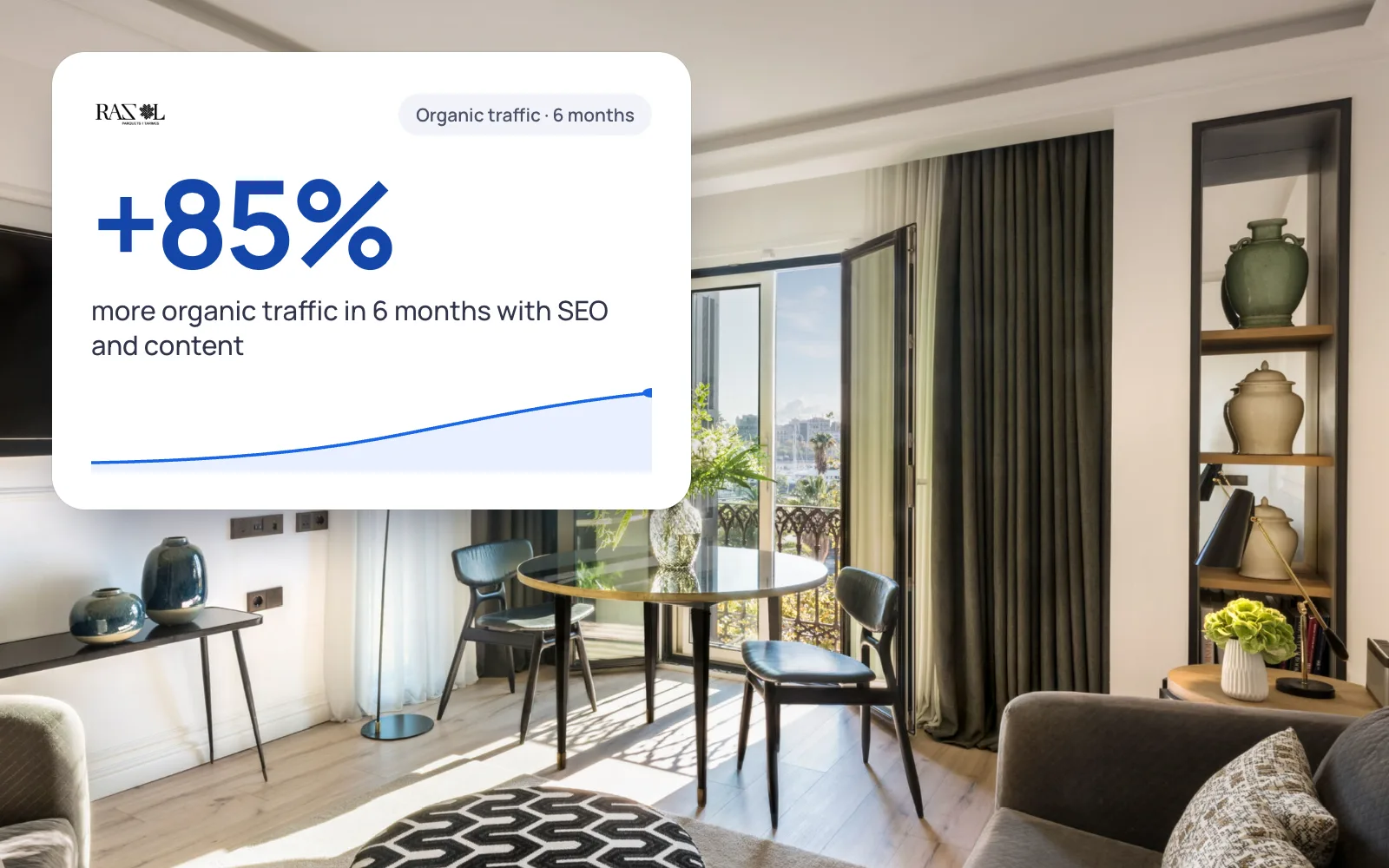 A real case+85%organic traffic in 6 monthsRazol Parquet · See the project →
The four factors that speed things up or slow them down the most
Within what you can control, there are four levers that make the difference between taking four months or twelve. The rest are details.
Technical speed (Core Web Vitals)
Google uses LCP, INP and CLS as ranking signals. A website with an LCP above 4 seconds starts at a disadvantage before it begins.
Domain authority
It is built with quality links and there is no real shortcut. Local press, partnerships, sector associations and the clients you already work for.
Content relevance
It is not about writing a lot, but about writing exactly what your customer is searching for. One well-targeted article is worth more than twenty generic ones.
Search intent
Optimising a service page as if it were a blog post, or the other way round, is one of the most costly and most frequent mistakes.

Technical SEO or content: which to start with
It is the most important strategic decision in any project, and the answer depends entirely on the state of your website.
If your website has serious technical problems (speed, URL structure, duplicate content, crawl errors), investing in content before fixing them is throwing money away: Google is not going to rank excellent content well on a broken base.
If the technical base is already healthy, then content is the engine. Every well-targeted article is an asset that works on its own for years, something no paid campaign gives you: the day you stop paying, you stop appearing.
That is why at GNERAI we always audit the technical state first and only then propose a content strategy. It is the only way not to burn budget in the wrong order. If you do not know what technical state your website is in, an SEO audit or the free digital check-up is the starting point: they tell you what is holding back your ranking and what is best fixed first.

«Every well-ranked article is a salesperson working 24 hours a day at no variable cost. But on a broken website, nobody is working.»
What you can do this week
If you do not yet have an active strategy, these are the three highest-impact actions you can carry out in seven days without anyone’s help.
- Measure your speedGo to PageSpeed Insights with your URL and look at the mobile LCP. If it is over 3 seconds, you have a brake that is dragging everything else down and no content can make up for it.
- Set up Google Search ConsoleIf you do not have it, you are missing the most valuable information Google gives away: which searches generate impressions, which pages it indexes and which errors it detects. Submit the sitemap the same day.
- Identify your five key searchesNot the ones you think are important, but the ones your customer uses when they have the problem you solve. The quickest and cheapest way to find out is to ask your best customers how they found you.
If you sell in your city, start with local SEO in Barcelona or, if you are in the Maresme, with local SEO in Mataró: it is the part of SEO that shows results soonest.
Getting your website indexed on its own and on time
A well-built website gets indexed quickly and without drama because it is born with the right technical base: sitemap, clean structure, internal links, structured data and speed. When that base fails, every new page becomes a fight with Google.
At GNERAI we build websites with technical SEO built in from day one and we set up Search Console, the sitemap and automatic indexing so your pages get into Google as soon as possible. If you are looking for a Google indexing service in Barcelona because your website is taking too long to appear or you have pages that are not being indexed, we will do a technical audit and get it sorted.
And if you also want to grow in search, we handle it as an SEO agency in Barcelona, with no tie-in and from €150/month.
We'll send you our next SEO guide
What's changing in Google and what works for our clients, explained for small businesses. No spam.
Guides for your business, in your inbox
What we publish on websites, SEO, ads and AI for small businesses. No spam, unsubscribe in one click.
Frequently asked questions
How long does it take a new website to rank on Google?
Indexing is a matter of days; ranking, of months. A new website with a domain with no history takes between 6 and 12 months to get consistent organic traffic, although it starts appearing for its brand name within weeks. If the domain already exists and only has a poor technical base, the timeline drops to 3-6 months.
How long does SEO take to work?
It depends entirely on the starting point: 2 to 4 months if your website already has a good technical base and only lacks content, 3 to 6 if technical problems need fixing, 6 to 12 on a new domain and 12 to 24 if it carries a penalty. Local SEO, with a well-optimised Google Business Profile, shows results in weeks.
What should I do first, technical SEO or content?
If your website has serious technical problems (speed, URLs, duplicates, crawl errors), fix them first: Google does not rank good content on a broken base, so investing in articles first is throwing money away. If the base is already healthy, content is the growth engine.
How long does Google take to index a new page on an existing website?
Much less than a new website: if the domain already has a history and you publish regularly, it normally takes between a few hours and three or four days. Requesting indexing in Search Console usually shortens it.
Why does my website appear on Google but nobody visits it?
Because being indexed does not mean being near the top. If you appear on page 2 or 3, hardly anyone will click: the first result takes most of the clicks. The work then is not indexing, but ranking and a title that invites people to click.
How long does Google take to index a new website?
Between about 48 hours and several weeks. A new domain with no authority and no links usually takes longer; if you submit the sitemap in Search Console and link to the page from others that are already indexed, you can cut it to a few days.
What is the difference between indexing and ranking?
Indexing is Google knowing about your page and storing it in its index; ranking is Google showing it near the top when someone searches. Indexing is a matter of days and ranking is months of work: you can be indexed and still not appear on the first page.
How can I tell if my website is indexed on Google?
Search Google for site: followed by the URL: if it appears, it is indexed. The most reliable way is Google Search Console’s URL Inspection tool, which tells you whether it is in the index, when it was last crawled and whether there is any problem.
How can I get my website indexed on Google faster?
Submit and maintain your sitemap.xml in Search Console, use URL Inspection and click Request indexing, implement IndexNow, link to the page from others that are already indexed and publish original, useful content. You do not force Google, but you make its job much easier.
Why is Google not indexing my website?
Almost always for a specific reason: a forgotten noindex tag, a block in robots.txt, a canonical pointing to another URL, duplicate or very short content, a page with no internal links or a sitemap that has not been submitted. Search Console’s URL Inspection tells you which it is.
My page is indexed but does not appear in searches. Why?
Because indexing is not ranking. Once in the index, your position depends on the relevance of the content, the domain’s authority, links and the competition for that search. It is normal for a newly indexed page to take weeks or months to climb for the queries that matter.
Further reading
Is your website taking a long time to appear on Google?
Request the free SEO audit and in less than 24 hours we tell you what is holding back your indexing and your ranking, and what we would fix first.