Best real estate CRM: how to choose one and when to go custom
There is no single best real estate CRM for every agency. For an agency with a classic profile (win listings, publish on portals, show and close), the sensible choice is a standard subscription CRM: Witei, Sooprema, Inmovilla or eGO Real Estate cover the essentials with different approaches. Choose by portals, listing acquisition, price per user or per property and how easy it is to get your data out. If your process is your advantage and you live in spreadsheets around the CRM, it is worth considering a custom one, which with us has a fixed quote based on the project.
1 / 10There is no universal best real estate CRM
Which is the best real estate CRM? The one that fits how your agency works, not the one that advertises the most features. In this guide we give you the criteria for choosing, a comparison of well-known programs in Spain based on what their own websites say, what to look for in real estate software with AI and the signs that a custom CRM is worth it for you.
There is no universal best real estate CRM
If you search for ‘the best real estate CRM’ you will find rankings that crown a different one each time, often written by the vendor itself. The reality is less exciting: the best one is the one your team uses every day without fighting it, publishes properly on the portals you work with and does not force you to build spreadsheets around it.
That is why this guide does not give you a winner. It gives you the criteria for choosing, what each well-known option offers according to its website and the line beyond which a standard CRM is no longer enough.
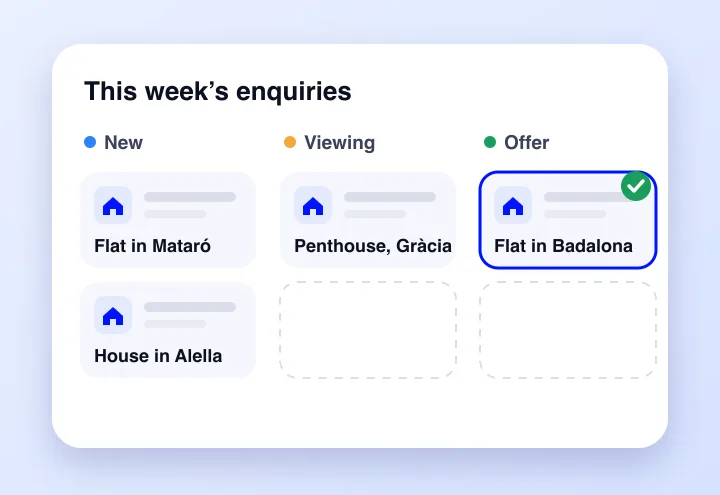
«A standard CRM solves what all agencies have in common. The problem is that your business competes on what it does not have in common.»
GNERAI team
What a real estate CRM is and what agencies really use
A real estate CRM is a program for managing properties, owners, buyers and tenants in one place, publishing the portfolio on the portals and following up each contact until signing. Unlike a generic CRM, it already comes with property records, matching between demand and supply and connection to portals.
If you look inside most agencies in Spain, the set-up is the same: a real estate CRM for the portfolio and contacts, automatic publishing on portals (Idealista, Fotocasa, Habitaclia…) and a collection of spreadsheets for everything the CRM cannot do. In small agencies, sometimes not even a CRM: WhatsApp, email and spreadsheets.
What a standard real estate CRM does well
- Property portfolio with records, photos and documents.
- Publishing and syncing with the portals.
- Customer database and automatic matching of demand and supply.
- Viewing diary and sales follow-up.
- A template agency website, connected to the portfolio.
If your agency has a classic profile and your process has no peculiarities, you probably do not need anything custom-built. A well-configured standard CRM gives you more value for less money and you have it up and running in days.
How to choose the best CRM for estate agencies: 8 criteria
Before asking for demos, write down what you need. These are the criteria that matter most in an agency’s day-to-day work:
- PortalsWhich ones it publishes to and whether it syncs price changes and withdrawals without you touching anything.
- Portal enquiriesWhether it collects them automatically, assigns them and replies quickly. This is where most deals are lost.
- Owner acquisitionTools for finding and following up sellers, not just buyers.
- WebsiteWhether it includes an agency website, whether you can use your own domain and whether it ranks on Google or is just a shop window.
- App and fieldworkRecords, photos and viewings from your phone.
- Pricing modelPer user, per number of properties or flat rate. Do the maths with your team as it will be in two years.
- Your dataWhether you can export complete properties and contacts the day you want to leave.
- TermsTie-in, set-up fee, support in Spanish and training.
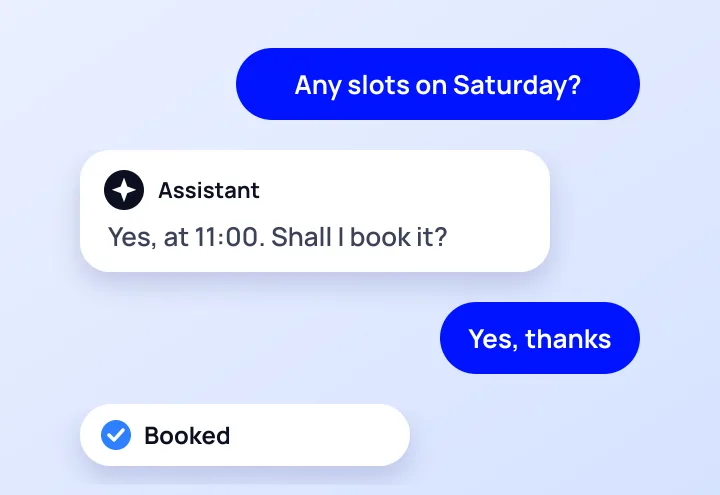
Ask for the demo with a real case from your agency: one property, one owner and three buyers. If the salesperson cannot set it up in front of you, your team will not either.
Comparison of real estate CRMs in Spain
These are some of the best-known real estate CRMs in Spain. We have not scored or ranked them: we summarise what each one’s official website says as of 27 October 2026. Prices and features change, so confirm them before deciding.

| CRM | What it focuses on according to its website | Published price |
|---|---|---|
| Witei | Acquiring seller owners, publishing on portals, automatic replies to portal enquiries, website with valuation tool and apps for iOS and Android | Not on the home page; no tie-in or set-up fee |
| Sooprema | Small and medium-sized agencies: more than 70 portals, AI descriptions in 14 languages, SEO-optimised website and app | From €39/month (up to 150 properties) |
| Inmovilla | Real estate software and CRM with AI, website connected to the CRM, property exchange (MLS) and WhatsApp | 15-day free trial |
| eGO Real Estate | CRM, agency website and listings on more than 200 portals worldwide; websites for Portugal, Spain and France | Not published; free demo |
Witei
It presents itself as a real estate CRM specialising in acquiring seller clients. According to its website, its SmartInbox technology processes the enquiries that come in from the portals, assesses their interest and sends an automatic personalised reply.
It includes demand matching, a website with a real-time valuation tool and an owner area, and states that there is no tie-in and no set-up fee.
Sooprema
It says it is aimed at small and medium-sized agencies. It publishes to more than 70 portals from one place, shows which portals bring the most real enquiries and writes descriptions with AI in 14 languages.
It is one of the few that publishes a price: its Starter plan, up to 150 properties, costs €39 a month, and for agencies with up to 2,500 properties it states ‘from €99/month’.
Inmovilla
It defines itself as real estate software and a real estate CRM with AI. Its website has sections on websites connected to the CRM, a property exchange (MLS) for sharing portfolios between agencies and WhatsApp integration, and it offers a 15-day free trial.
eGO Real Estate
It brings together CRM, agency website, campaigns and portal listings, and claims to be the only real estate CRM that lets you advertise on more than 200 portals worldwide at once. It has websites for Portugal, Spain and France, which makes it interesting if you work with foreign buyers. It does not publish prices.

Open-source real estate CRM
There are open-source CRMs such as EspoCRM or SuiteCRM, which present themselves as such on their websites. They are generic: they do not come with property records or portal connections, so they have to be adapted.
They make sense if you have someone technical in-house or if you want your own base to build on; for an agency that only wants to publish and sell, they usually end up costing more in hours than a subscription real estate CRM.
Real estate software with AI: what to look for
Almost every program now advertises ‘AI’. To avoid comparing labels, look at which specific task it saves you:
- Writing and translating property descriptions: useful, but review them before publishing.
- Replying to and sorting enquiries from portals and WhatsApp in minutes, not hours.
- Reading documents (land registry extracts, contracts, ID documents) and filling in records.
- Preparing reports for owners or investors without putting them together by hand.
- Flagging opportunities: new matches, price drops, properties that have gone weeks without viewings.
If what you want is to automate your agency beyond the CRM (website forms, follow-ups, reminders, reports), very often you do not need to change program: it is enough to connect it to everything else. We explain it in process automation.
Where a standard CRM falls short
The signs that your agency has outgrown its CRM come up again and again among the estate agencies that call us:
- Your operations live in spreadsheets around the CRM: valuations with your own method, new-build tracking, settlements with partners, reports for owners or investors.
- The processes that make you money do not fit in the tool: acquisition with your own criteria, opportunity scoring, investor workflows, integration with valuers or with your accounts.
- You pay per-user licences for features you do not use, while what you actually need does not exist.
The acid test: count how many spreadsheets live around your CRM. If there are more than three, your real process is no longer in the CRM.
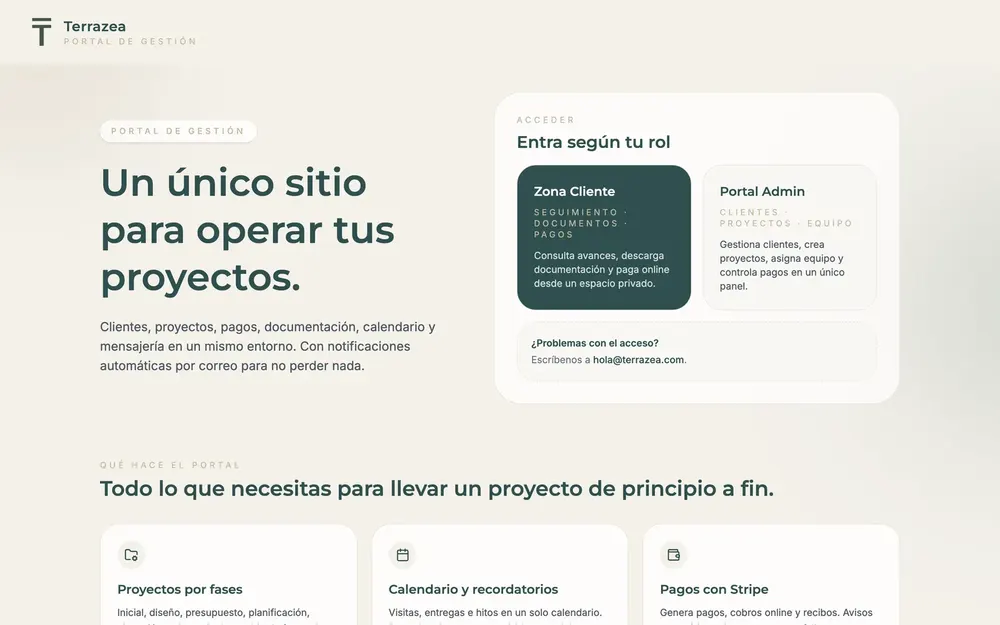
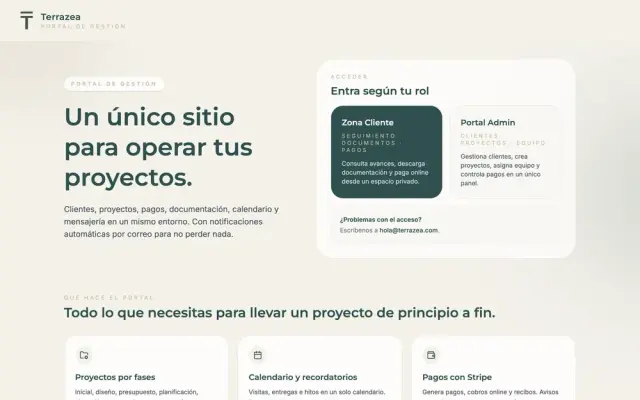 A real case−60%time spent on admin tasksTerrazea · See the project →
When a custom real estate CRM pays off and how much it costs
Custom real estate software pays off when your advantage lies in the process, not just in how you treat clients: your own valuation method, systematic opportunity sourcing, portfolio management for investors or a volume at which every minute saved per deal is money.
Unlike a subscription CRM, it is yours: no per-user licences, built for your workflow and connected to what you already use (portals, accounts, digital signature). With built-in AI it can also read documents, sort enquiries or prepare reports.
Custom-built does not mean ‘everything from scratch’. A well-scoped project begins with a first module, the one that hurts most, and grows in phases only if the numbers add up. It can even coexist with your current CRM.
It could be, for example, real estate software for screening that monitors bank-owned flats, servicers and BOE auctions (Spain’s Official State Gazette) and calculates the net profit on each property. You will find it all in custom real estate software.
What about free real estate software?
Free or nearly free real estate software exists: free plans from some CRMs, templates or the eternal spreadsheet. To start with two deals a month, it may be enough.
The cost appears later: limits on properties or users just when you are growing, data that is hard to get out and hours of manual work. In an estate agency, time means viewings you do not do and instructions you do not win.
Our recommendation: free to confirm that you need a system, a paid standard tool when your operations are classic, custom when your process is your advantage. In that order.
How to decide in 10 minutes
Answer these with your team and the decision almost makes itself:
- How many spreadsheets live around your CRM? Three or more: you have hit the ceiling.
- Is your valuation or acquisition method different from your competitors’? If so, custom adds value.
- How many hours a week are lost copying data between tools? Put a price on them.
- Do you pay for features you do not use while missing the ones you need? A classic sign.
- Do you manage investors, funds or new builds with your own reports? Standard tools rarely stretch that far.
- Does your volume justify saving half an hour per deal? Multiply by the year’s deals.
And if the bottleneck is not the tool but the fact that deals are not coming in, the problem is a different one: we deal with it in real estate marketing and in the guide to digital marketing for estate agencies.
More real examples: UDB Sports
We'll send you our next software and AI guide
Automations, software and real cases to save hours in your business. No spam.
Guides for your business, in your inbox
What we publish on websites, SEO, ads and AI for small businesses. No spam, unsubscribe in one click.
Frequently asked questions
What is a real estate CRM?
It is a program for managing properties, owners, buyers and tenants in one place, publishing the portfolio on the portals and following up each contact until signing. Unlike a generic CRM, it comes with property records, matching between demand and supply and connection to portals such as Idealista or Fotocasa.
What is the best CRM for estate agencies?
There is no single best one for all of them. It depends on your size, the portals you work with, whether you focus on winning owners or buyers and the pricing model that suits you. Ask for demos with a real case from your agency and check that you can export your data if you ever leave.
What is the best real estate software in Spain?
For an agency with a classic profile, any established real estate CRM with good portal connections, an app and support in Spanish covers the essentials; Witei, Sooprema, Inmovilla or eGO Real Estate are well-known options with different approaches. If your process is your own, the best software may be custom-built.
How much does a real estate CRM cost?
Subscription ones are paid monthly, per user or by number of properties. For example, Sooprema publishes a plan from €39 a month for up to 150 properties. A custom real estate CRM with us begins with a first module, with a custom quote, and has no per-user licences.
Is there an open-source real estate CRM?
There are open-source CRMs, such as EspoCRM or SuiteCRM, but they are generic: they do not come with property records or portal connections. They work as a base if you have a technical profile or want to build something of your own. For an agency that only wants to publish and sell, a subscription real estate CRM is usually the better option.
What free real estate software can I use?
To confirm that you need a system, a free CRM plan or a well-built spreadsheet will do. Their cost appears as you grow: limits on properties or users, data that is hard to migrate and hours of manual work. Free to start, yes; to operate seriously, it turns out expensive.
When does a custom real estate CRM pay off?
When your advantage lies in the process: your own valuations, systematic acquisition, reports for investors or a high volume of deals. If you maintain more than three spreadsheets around the CRM, that is a good sign. You start with a module, with a fixed quote, and expand only if the numbers add up.
To help you decide
An off-the-shelf or a custom CRM for your agency?
Work out for free how much you would save. Within 24 hours we tell you whether a standard CRM is enough or whether custom development pays off for you, with no obligation.