SEO for restaurants: how to get on Google Maps and fill tables
SEO for restaurants means appearing on Google Maps and on Google when someone searches for somewhere to eat nearby. It is built on a complete Google Business Profile (a precise category, real photos, the menu, up-to-date opening hours and a booking link), recent reviews that have been replied to, and a fast website with the menu as text, not as a PDF.
1 / 10Why a restaurant’s SEO is decided on the map
SEO for restaurants is played out almost entirely on Google Maps. Someone searches for “where to eat in Mataró” or “restaurant near me”, looks at three profiles, their photos and their reviews, and books at one of them. In this guide we explain what to work on in your profile, your menu and your website so that the profile they choose is yours, and how to find out how many tables it brings you.
Why a restaurant’s SEO is decided on the map
When someone searches for a place to eat, Google understands that they want something nearby and shows them a map with three restaurants before any website. Each with its rating, its photos, its opening hours and a button to call, get directions or book. Many people choose there, without scrolling any further.
That is why a restaurant starts with its Google Business Profile. The website comes afterwards, and it counts: it is where Google and the customer read your menu, and where bookings do not go through intermediaries.
This guide is about the how: what to do yourself, step by step. If what you are looking for is someone to do it for you and what it costs, you will find that on our restaurant marketing page.

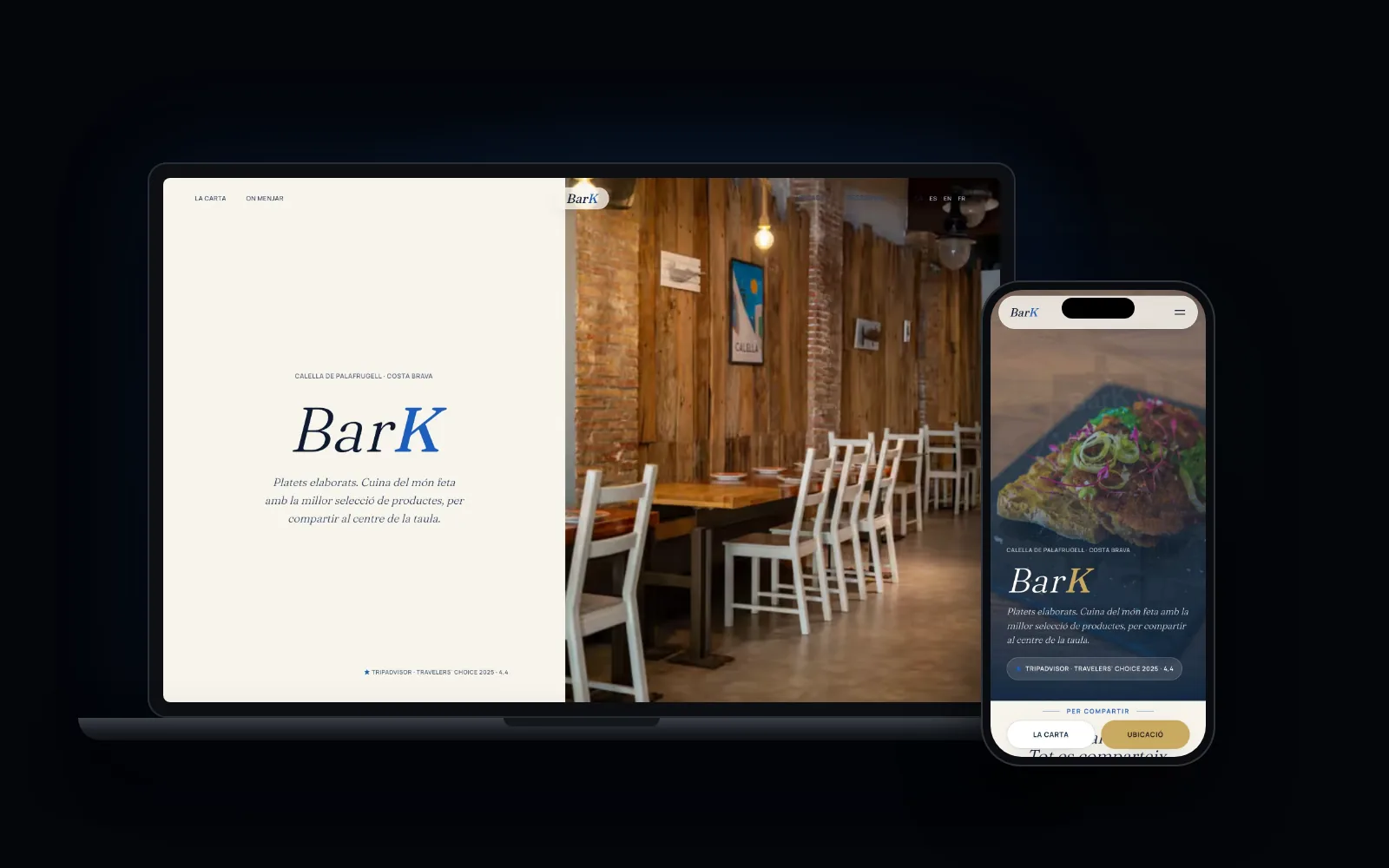
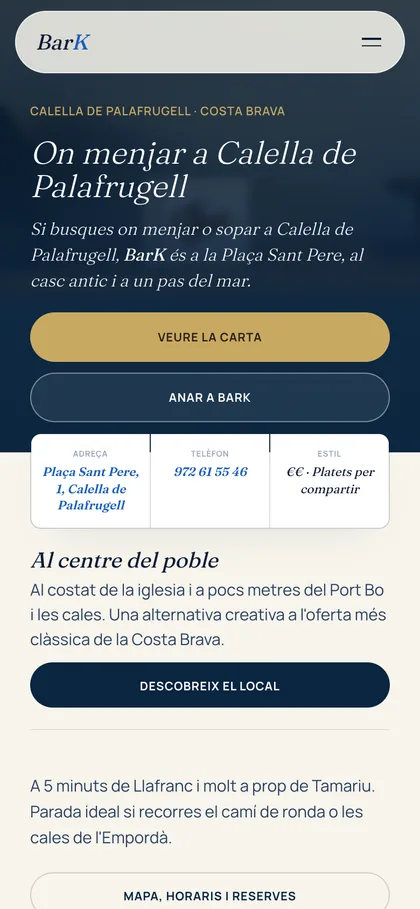
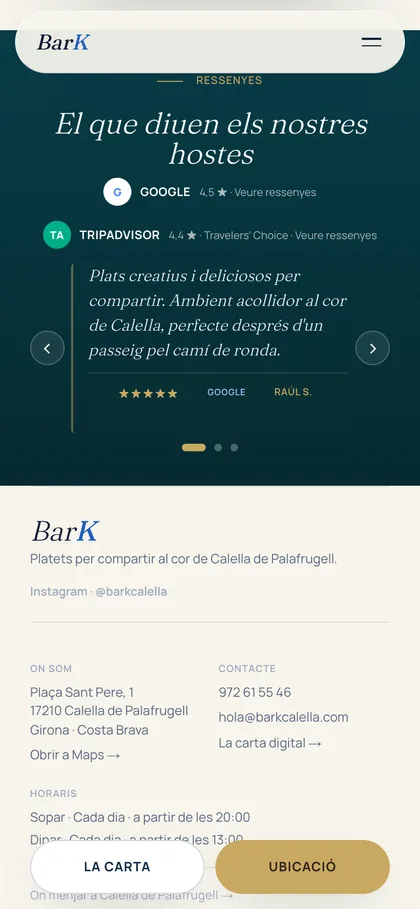
BarK's website on a phone: their own photos, the menu and booking without leaving the page.
How people search for where to eat
Almost all your customers’ searches fit into four types, and each one is won with a different piece:
| Type of search | Example | What wins it |
|---|---|---|
| Proximity | “restaurant near me”, “where to eat around here” | A complete profile, a precise category and being open at that moment |
| Area | “where to eat in Gràcia”, “restaurants in Arenys de Mar” | A profile and a website that names your neighbourhood or town |
| Dish or cuisine | “rice dishes in the Maresme”, “brunch in Sant Gervasi” | Category, a text menu and reviews that mention that dish |
| Occasion | “restaurant for groups in Mataró”, “terrace in El Masnou” | Profile attributes and a page for groups or events |
Proximity searches depend heavily on distance, which you do not control. Dish and occasion searches you can win even if there are ten restaurants closer by.
Your restaurant’s Google Business Profile, field by field
If you have not yet claimed or verified your profile, start there; we explain it step by step in what local SEO is and how Google Business Profile works. Once the profile is yours, this is what makes the biggest difference for a restaurant:
Categories
The primary one should say what type of restaurant you are, as specifically as possible: “tapas restaurant”, “seafood restaurant” or “pizzeria” rather than just “restaurant”. Additional ones only if they are true.
A tapas bar that also serves a set lunch menu can add that category; one that has a single pizza on the menu is not a pizzeria.
Photos
Upload your own so that customers’ photos, which tend to be dark, are not the only ones: the front of the restaurant (so people can find you in the street), the dining room, the terrace if you have one and your best-selling dishes, in daylight. Update them when the menu changes.
Menu
Google lets food businesses add their menu to the profile and link to the one on their website. Do both, and make sure the link goes to the menu on your website, not to a PDF. If the menu on the profile has dishes you no longer serve, customers notice when they sit down.
Opening hours
The regular hours and the special ones: bank holidays, Sant Joan (Midsummer’s Eve), Christmas, holidays and seasonal changes, which are common in the Maresme. If Google says “open” and people find the shutters down, you lose that table and may earn yourself a one-star review.
Bookings and attributes
Depending on the booking system you use, Google shows a book button or lets you add the link. Better if it leads to your website or your own system. In the attributes, tick only what you have: terrace, takes bookings, good for groups, vegetarian options, takeaway.
No keywords in the name: the profile name is the one on your sign. Adding “best paella in Mataró” goes against Google’s guidelines and can get you suspended.
Reviews: what decides between two restaurants
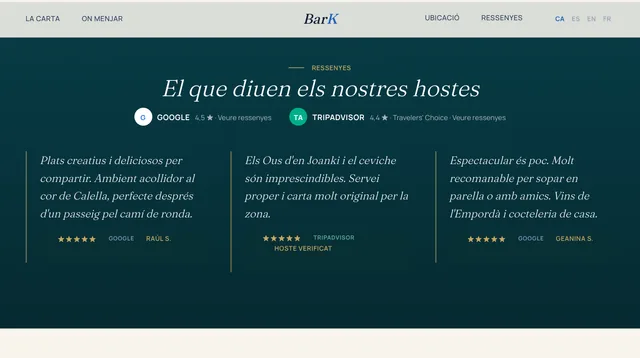
Google says that positive reviews and ratings can improve your local ranking. And for someone choosing while hungry with their phone in hand, between two similar profiles the one with more recent, better answered reviews usually wins.
- Ask for them at the end of the meal, when you bring the bill, with a QR code on the table or on the receipt that goes straight to your profile.
- Reply to all of them, including the three-star ones, with a specific detail rather than a copied “thank you for your visit”.
- Negative ones calmly and without arguing. The person reading your reply is your next customer, not the one who complained.
- Pay attention to what they say. If reviews mention your rice dishes or your terrace, Google links your profile to those searches.
What you cannot do: offer a free dessert in exchange for a review, ask only the happy tables, or have your staff write them. Google’s policy forbids it.
The menu on your website, as text and not as a PDF
A PDF menu is the most common mistake. On a phone you have to zoom in with two fingers, and every change of dish means redoing the file. Google can read some PDFs, but as a stand-alone document, not as your restaurant’s menu.
A menu written on the page itself reads well on any phone, you can change it in a minute and Google understands what you serve. If someone searches for “fideuà in Vilassar de Mar” and your menu includes fideuà, that is text Google can link to the search. If it is inside a PDF or a photo, much less so.
- Dishes with a name and a short description, by section, with prices.
- Allergens marked on each dish. You already have to provide this information on the premises; having it on the website saves questions at the table.
- Several languages if you have customers from abroad, which is common in the Maresme in summer and in central Barcelona all year round.
- Restaurant structured data: type of cuisine, opening hours, links to the menu and to bookings, so that Google does not have to guess them.
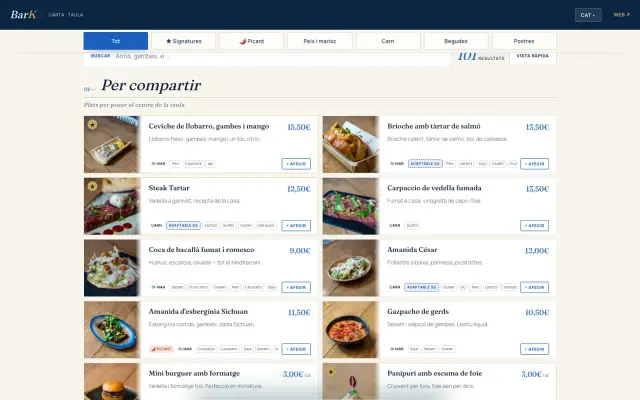
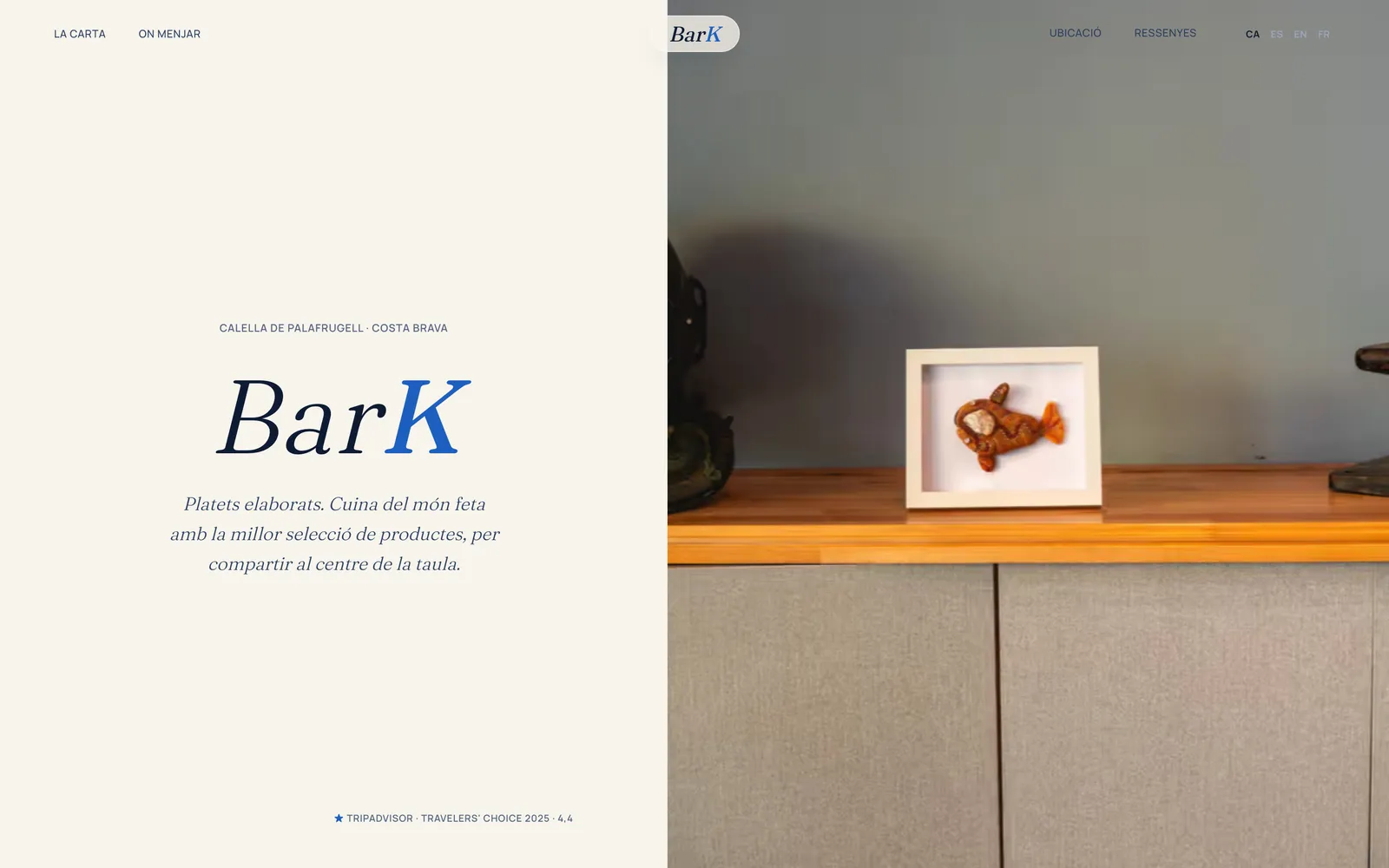
One of our examples: for BarK, a small-plates restaurant in Calella de Palafrugell, on the Costa Brava, we built a digital menu with more than 100 dishes, category filters, allergens and a photo of each dish, in four languages. You can see it in the BarK Calella case study.
A website that answers “where to eat in…”
Your profile links to your website and Google reads them together. A restaurant does not need a huge website. It needs a few pages, each with a reason to exist:
- Home page saying what type of cuisine you serve, which neighbourhood or town you are in, and a book button visible without scrolling.
- Menu, and separately the set lunch menu if you have one, which is searched for a lot around midday.
- Groups and events: company meals, birthdays, first communions. With capacity, set menus and how to request a quote.
- How to get here: address, parking, the nearest metro stop or Rodalies (local commuter rail) station.
Name your area the way your customers name it: the neighbourhood in Barcelona; in the Maresme, the town and how far you are from the beach or the harbour, which is what visitors ask.
The rest is SEO for any website: fast loading on mobile and an identical name, address and phone number on the profile, the website and directories. You will find it in how to rank your website on Google.
Events and seasons: get ahead of the calendar
Many people search weeks in advance for what they want to celebrate. If your calçotada page goes live in February, you are too late: whoever was searching in January has already booked elsewhere.
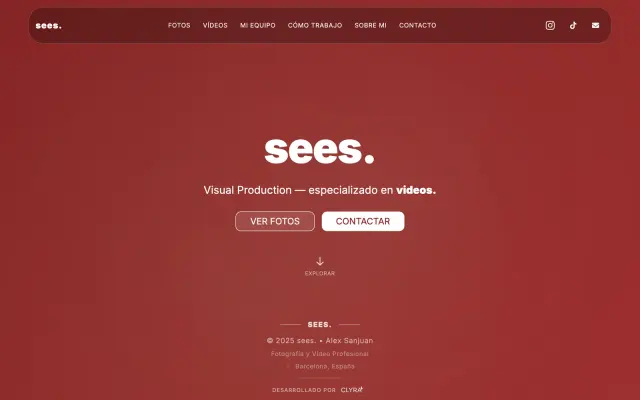 Real exampleSEES ProductionAn editorial online presence for a high-end audiovisual production company.+140% time on siteSee the project →
| When | What people search for | What to prepare |
|---|---|---|
| November and December | Company dinners, Christmas lunch, Sant Esteve (St Stephen’s Day) | Set menus with prices on the website, a month in advance |
| January to March | Calçotadas (spring onion feasts), calçotadas for groups | A calçotada page with menu and price, before the season starts |
| Spring | First communions, family meals | A groups page with capacity and menus |
| Summer | Terrace, near the beach, open in August | Terrace photos, summer opening hours and the website in other languages |
| Festa Major (town festival) | Where to eat during the Santes festival in Mataró or your own town’s festival | Special opening hours and a post on your profile |
Profile posts are made precisely for this: a seasonal menu, a live music night, closing for the holidays.
Common mistakes in restaurant SEO
- The menu as a PDF or a photo, or the menu from two seasons ago.
- Summer opening hours in the middle of November, or bank holidays not marked.
- Duplicate profiles after a change of ownership or name: reviews are split and customers do not know which one is right.
- Unanswered reviews, especially bad ones.
- Relying only on booking platforms: customers find you, but the relationship and the data stay with the platform.
- A hidden book button at the bottom of the page, or only a phone number.
If you would like a second opinion on your profile, that is what the free Google Business Profile review is for.
How to measure the bookings Google brings you
Rankings aside, what matters is how many tables come from Google. It can be measured quite well with free tools:

- Profile performanceGoogle Business Profile shows you calls, direction requests and clicks to the website. Compare with the same month the previous year: August and November look nothing alike for a restaurant in the Maresme.
- Tagged linksAdd UTM parameters to the website and booking links on your profile so that Google Analytics separates the visits that come from the map.
- Clicks on bookMeasure in Analytics every click on the book button and every completed booking, if your system allows it.
- Your booking systemIf it records where each booking comes from, check it every month.
- Ask in the dining room“How did you hear about us?” when taking a booking by phone. It is not very precise, but it confirms what the numbers say.
If calls and direction requests go up but web bookings do not, look at the website; if nothing goes up, look at the profile.
If you would rather we handled it, we work on local SEO in Barcelona and the Maresme from €150/month with no tie-in. The details are in SEO prices.
Projects we have worked on
We'll send you our next SEO guide
What's changing in Google and what works for our clients, explained for small businesses. No spam.
Guides for your business, in your inbox
What we publish on websites, SEO, ads and AI for small businesses. No spam, unsubscribe in one click.
Frequently asked questions
What is SEO for restaurants?
It is the work that makes your restaurant appear on Google and Google Maps when someone searches for somewhere to eat nearby. It rests on the Google Business Profile, reviews and a fast website with the menu as text.
How do I get my restaurant on Google Maps?
Claim and verify your Google Business Profile, choose a precise primary category, fill in opening hours, menu, photos and attributes, and get reviews every week. You do not control distance; everything else, you do.
Can I pay to appear first on the map?
In the regular map results, no: Google says you cannot pay for a better position. What does exist is ads, which are labelled as sponsored and paid for separately.
Is it bad to have the menu as a PDF?
For SEO and for customers, yes. It is hard to read on a phone, awkward to update and Google understands it less well than a menu written on the page itself. You can keep the PDF as a download, but the main menu should be text.
How many reviews does a restaurant need?
There is no magic number. Look at how many the three restaurants at the top in your area have. The pace matters too: reviews from last week inspire more confidence than lots from years ago.
How long does a restaurant’s SEO take to show?
Climbing in competitive searches, such as “where to eat in central Barcelona”, takes months. In towns in the Maresme, with less competition, a well-optimised profile usually shows results sooner.
Do I need a website if I already have a Google Business Profile?
It is worth having one. The website is where Google reads your menu and your area, and where bookings do not go through intermediaries. The profile and the website reinforce each other.
Further reading
Why is your restaurant not showing on the map?
Ask for the free review of your Google Business Profile. We review your Google Business Profile, your reviews and your website, and in less than 24 hours we tell you what we would change first.