
What is SEO and how does it work: the guide to understanding it once and for all
SEO (Search Engine Optimization) is the set of improvements to your website so that Google understands it, considers it useful and shows it in the organic results, the ones that are not ads. Google crawls pages, stores them in its index and ranks them for each search; SEO works on those three stages on three fronts: the technical side, the content and the authority other websites give you. Results come in months, not days, and nobody can guarantee you a position.
1 / 11What SEO is, in one sentence
What is SEO? It is the work of getting your website into the top results on Google when someone searches for what you offer, without paying for each click. Here we explain it without jargon: how Google decides what to show, what parts SEO has, what does not work even if someone sells it to you and how long it takes to show results.
What SEO is, in one sentence
SEO stands for Search Engine Optimization. In practice, it is everything you do so that your website appears when someone searches Google for something related to your business, and so that the person has reasons to click.
Google’s own SEO guide sums it up as helping search engines understand your content and helping people find your website and decide whether to visit it. Notice that it does not talk about tricks: it talks about Google understanding what you do and about your page being the best answer for the person searching.
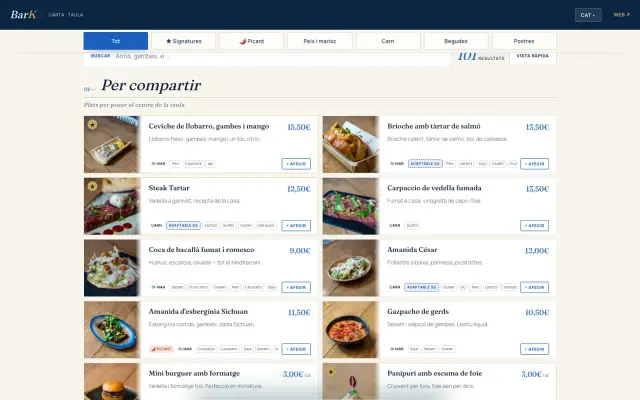
When someone talks about SEO rankings, search rankings or organic rankings, they mean the same thing: the place your website holds in the results Google does not charge for. The ads that appear at the top with the ‘Sponsored’ label are something else (SEM or Google Ads), and we look at them further down.
«Google does not reward whoever knows most about SEO. It rewards whoever best answers what people are looking for. SEO is making that show.»
GNERAI team
How Google works: crawling, indexing and ranking
To understand how SEO works you first need to understand how Google works. According to its official documentation, Search works in three stages, and SEO plays a part in all three:
- CrawlingA program called Googlebot travels the internet following links and downloads the text, images and videos of the pages it finds. It does not crawl everything it discovers.
- IndexingGoogle analyses each page (text, tags, images) and stores it in its index, a huge database. If there are duplicate pages, it chooses one as the main one. Google warns that indexing is not guaranteed.
- Serving resultsWhen someone searches, Google consults its index and ranks the pages it considers most useful, taking into account hundreds of factors, including the location, language and device of the person searching.
Two statements from that same documentation are worth bearing in mind: Google does not accept payment to crawl a website more often or to rank it higher, and it does not guarantee to crawl, index or show any page even if it follows all its rules. That is why you should be wary of anyone who ‘assures’ you first place.
If a page is not indexed, it does not exist for Google, however much work you put into it. We explain how to check it and how long it takes in how long Google takes to index a website.
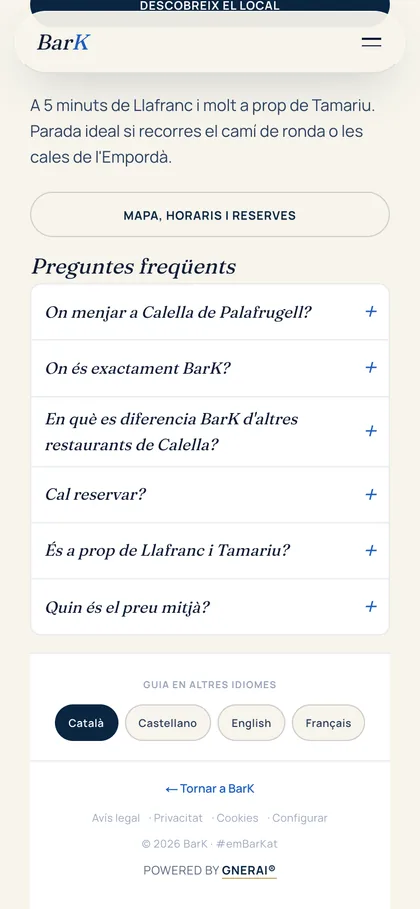
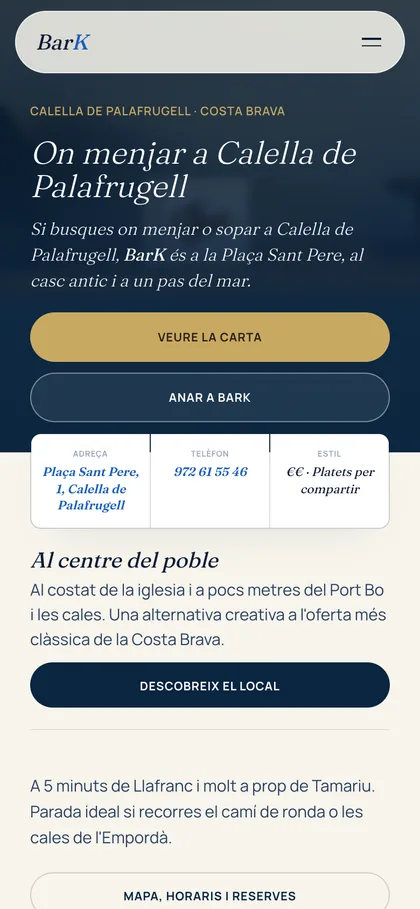
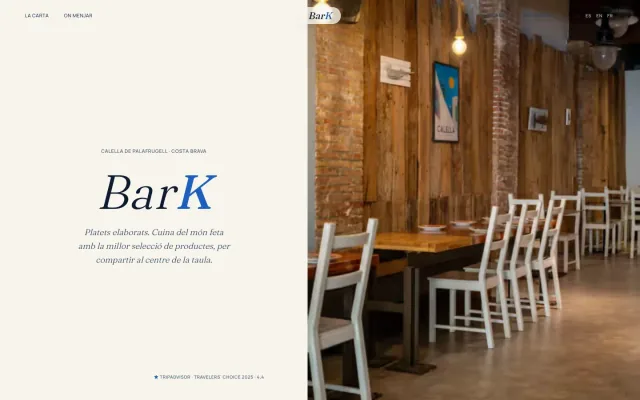 Real exampleBark CalellaMultilingual website and interactive digital menu for a small-plates restaurant on the Costa Brava.4.5★ average rating on GoogleSee the project →
The types of SEO: technical, on-page and off-page
Website SEO is usually divided into three parts. They are not separate services: if one fails, the other two deliver less.
| Type | What it works on | Question it answers |
|---|---|---|
| Technical SEO | Crawling, indexing, speed, mobile, redirects, structured data | Can Google read my website without problems? |
| On-page SEO | Text, titles, headings, keywords, internal links | Does Google understand what each page is about, and does it answer the search? |
| Off-page SEO | Links from other websites, mentions, reviews | Do others trust my website? |
Technical SEO: letting Google in to read
It is the foundation. It includes making sure important pages are not blocked, that there is a sitemap, that there are no redirect chains, that the website loads quickly on mobile and that each piece of content has a single URL.
When we reviewed 400 business websites in Barcelona and the Maresme, more than half of those with data failed Google’s mobile speed measurement; we cover it in how to do an SEO audit.
On-page SEO: each page answering one search
It is what happens inside each page: that it has a clear topic, that it uses the words your customer searches with, that the title and headings reflect it and that the content resolves what the person wanted to know.
The most useful rule: one page for each important search. If you do bathroom and kitchen renovations, each service deserves its own page.
Off-page SEO: your reputation outside your website
Google also looks at what happens outside: whether other websites link to you, whether media or directories in your sector mention you and, for local businesses, your reviews. A link from a relevant website works like a recommendation. Ten links bought on websites nobody visits do not.
The basics: SEO title, H1, slug and CTR
These are the words you will hear most when someone talks to you about SEO. With these four you can already follow any conversation with an agency.
| Term | What it is | Example |
|---|---|---|
| SEO title (title tag) | The page title that usually appears in blue on Google | ‘Physiotherapist in Mataró | Your Clinic’ |
| Meta description | The short text that may appear below the title | Two sentences on what you offer and why choose you |
| H1 | The main visible title inside the page | ‘Sports physiotherapy in Mataró’ |
| Slug | The final part of the URL that identifies the page | /sports-physiotherapy |
| CTR | Percentage of people who click after seeing your result | 1,000 impressions and 30 clicks = 3% |
A nuance about the title: according to Google’s documentation, the title shown in the results is generated automatically and, although it usually uses the one you write, it may take other text from the page (for example, the H1) if it thinks it describes the content better. That is why the title and H1 should say the same thing in similar words.
You can see the CTR for free in Google Search Console, for each page and each search. If you have many impressions and few clicks, the problem is usually not the position but a title or description that does not invite people in.
What really matters for ranking (and what is a myth)
Google does not publish the list of factors or their weight, and anyone who says they have it is exaggerating. What is clear, because Google repeats it in its documentation and because we see it every month on real websites, is this:
Content that answers the search
First and foremost. If someone is searching for a price and your page does not talk about prices, no technique will fix it.
A website Google can read
Indexable, fast on mobile and free of errors that block it.
Well-chosen keywords
The ones your customer uses, not the ones you use internally.
Authority
Links and mentions from relevant websites. It is hard and slow, but it makes the difference in competitive sectors.
User experience
That the page is easy to understand, reads well on mobile and leads to the next action.
Three myths that Google itself refutes
The meta keywords tag is useless
Google’s SEO guide says its search engine does not use it.
There is no magic word count
The same guide says that content length on its own does not matter for ranking.
Putting keywords in the domain barely helps
It matters more that the name is one your customers remember.
Black hat SEO: shortcuts that cost you dearly
Black hat SEO is the name for techniques that try to trick Google instead of improving the website. Google groups them in its spam policies and warns that a website that breaches them can drop in the results or disappear from them, sometimes with a manual action reviewed by a person. The most common on small business websites:
- Buying or selling links to climb positions.
- Stuffing text with keywords until it no longer reads naturally.
- Hidden text: words the same colour as the background or hidden from the visitor.
- Doorway pages: dozens of almost identical pages with only the name of the town changed.
- Large-scale content with no value, including AI-generated content, just to take up space in the results.
If an agency promises you lots of links a month for little money or results in a few weeks, ask where they come from. Recovering a penalised website costs much more than doing it properly from the start.

SEO and SEM: how they differ
It is the most common question. SEO works on the organic results; SEM (search engine marketing) is almost always used to refer to paid ads, which on Google are managed with Google Ads. Both appear on the same results page, but they work differently:
| SEO | SEM (Google Ads) | |
|---|---|---|
| How you pay | With work on your website, not per click | For each click |
| When visits arrive | In months | The same day |
| If you stop investing | What you have gained holds for a while | You disappear immediately |
| Best for | Building a stable channel | Selling now, launching something, seasonal peaks |

They are not rivals. Many small businesses start with ads to get enquiries from the first month and let SEO take over. We compare them with numbers in SEO or Google Ads: which to choose and in our guide to Google Ads for small businesses.
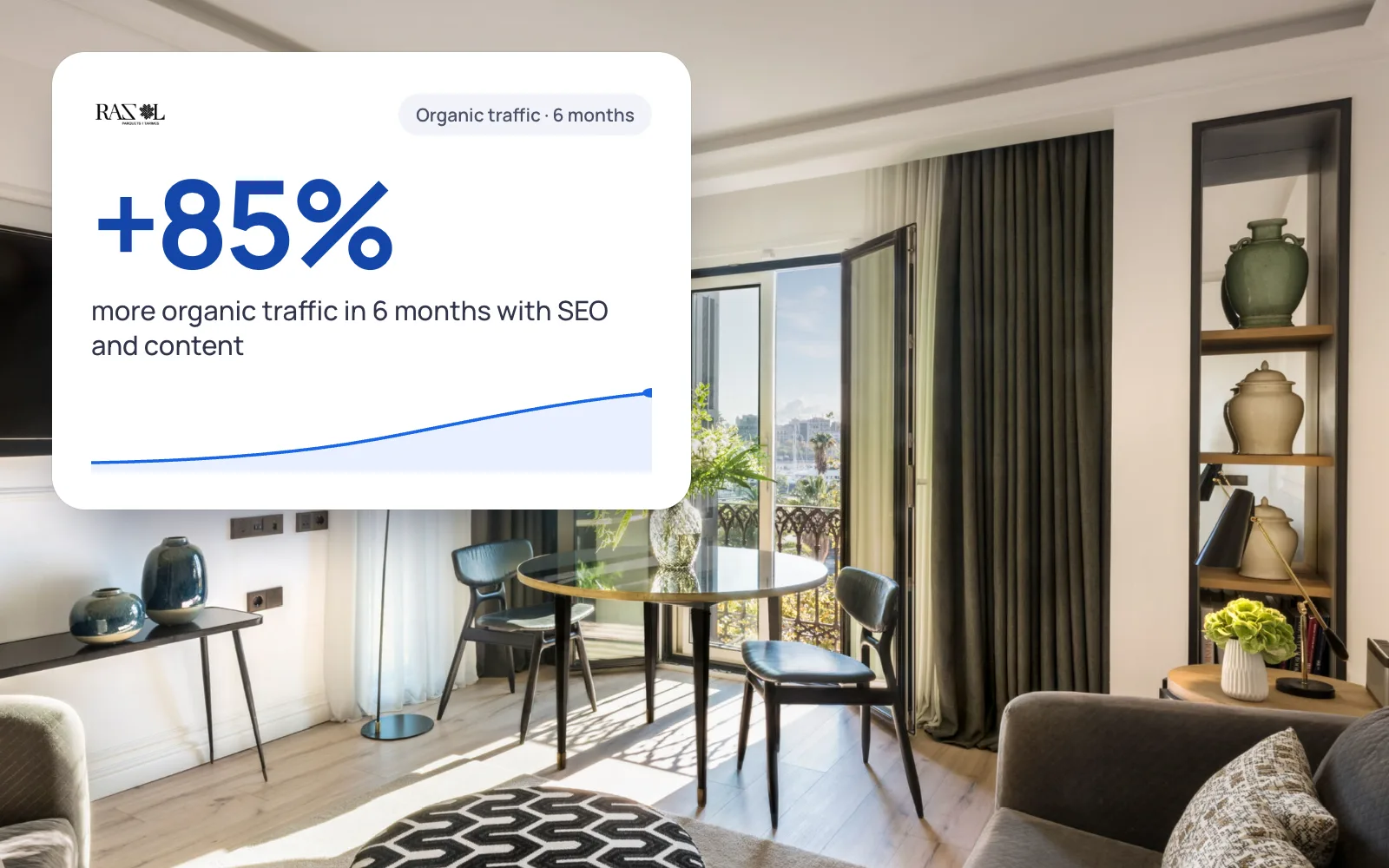 A real case+85%organic traffic in 6 monthsRazol Parquet · See the project →
Local SEO, semantic SEO and SEO for AI
Within SEO there are specialities worth distinguishing, because not everyone needs all of them:
- Local SEO. For businesses that rely on nearby customers: appearing on the Google map with your Google Business Profile and your reviews. We explain it step by step in what local SEO is.
- Semantic SEO. Writing by topic rather than by individual words: covering related questions, using synonyms and the real vocabulary of the sector, so that Google understands the whole topic and not one repeated word.
- SEO for AI. Getting ChatGPT, Gemini or Google’s AI summaries to cite your website. It rests on the same things as traditional SEO, plus a few adjustments. We explain it in SEO for AI.
 Real exampleSEES ProductionAn editorial online presence for a high-end audiovisual production company.+140% time on siteSee the project →
How long SEO takes to deliver results
Google’s guide says that a change can show up in a few hours or in several months, and recommends waiting a few weeks before judging whether it has worked. Our experience is along the same lines: technical fixes show up soon, and climbing for competitive searches normally takes between 3 and 6 months.
A real example: at Razol Parquet we worked on the website and the SEO and organic traffic rose by 85% in 6 months. They started from a website with a clear product and a specific sector; not every case moves as fast.
SEO accumulates: a page that ranks today keeps bringing you visits as long as it remains useful and the competition does not overtake you. That is why it pays to start early even though results take time.

Why SEO matters for a small business
Because whoever finds you on Google already has a need. You are not interrupting them as with a social media ad: they are looking for you. For a small business that means enquiries with purchase intent without paying for each click, and a website that works even when you are not doing anything.
Where to start if you are starting from scratch
- Register your website in Google Search Console and check which pages it has indexed.
- Make a list of the searches a customer would find you with and check whether you have a page for each one.
- Check with PageSpeed Insights that the website loads quickly on mobile.
- If you serve a local area, complete your Google Business Profile.
- Follow the order in our guide to ranking your website on Google.
If you would rather have a team do it, at our SEO agency in Barcelona we work on SEO from €150/month with no tie-in, and because we also build websites, we make the technical changes ourselves.
We'll send you our next SEO guide
What's changing in Google and what works for our clients, explained for small businesses. No spam.
Guides for your business, in your inbox
What we publish on websites, SEO, ads and AI for small businesses. No spam, unsubscribe in one click.
Frequently asked questions
What are SEO rankings?
They are the place your website holds in Google’s organic results for a search, and also the work of improving it. You achieve them by making sure Google can read your website, that each page answers well what people are looking for and that other websites vouch for you with links and mentions.
What are SEO and SEM?
SEO works on Google’s organic results, where you do not pay for each click; it takes months but it accumulates. SEM almost always refers to paid search ads, such as Google Ads: results from day one, but you disappear when you stop paying. Combining them is the usual approach.
What is SEO in marketing?
It is one of the channels of digital marketing: the one that wins customers through Google searches without paying per click. It is combined with advertising, email or social media, and it usually gives the best cost per customer in the long run, because the work done keeps paying off.
What is technical SEO?
It is the part of SEO that makes sure Google can crawl, understand and index your website: mobile speed, sitemap, robots.txt, redirects, duplicate URLs, structured data and server errors. If it fails, the content never gets to compete, however good it is.
What are on-page and off-page SEO?
On-page SEO is what you do inside your website: text, titles, headings, keywords and internal links. Off-page is what happens outside: links from other websites, mentions and reviews. The first tells Google what your page is about; the second, whether others trust it.
What is CTR in SEO?
It is the percentage of people who click on your result after seeing it on Google. If you appear 1,000 times and get 30 clicks, your CTR is 3%. You can see it for free in Google Search Console. A low CTR with many impressions usually points to an unappealing title or description.
What is SEO content?
It is the text on your website written to answer what your customer is looking for, in the words they use: service pages, guides, frequently asked questions. It is not repeating keywords, it is covering a topic well so that Google understands it and the person finds what they wanted.
Can anyone guarantee me first place on Google?
No. Google states in its documentation that it does not accept payment to rank higher and that it does not guarantee to show any page. A serious agency can promise you work, method and transparency, not a position. Be wary of anyone who guarantees it.
Further reading
Want to know how Google sees your website?
Request the free SEO audit and within 24 hours we tell you what is holding your website back on Google and where we would start.